
Dispatch from Namibia: Part 1, August 2026

Our Dear Leader has been on his annual two-week summer business trip, and this year it has been to Namibia, visiting five companies; Arkle Resources (ARK LN), Andrada Mining (ATM LN), Koryx Copper (KRY CN) and Ongwe Minerals (OGW CN). Highlighting the rising interest in Namibia, two of these companies only acquired their Namibian projects this year! For good measure, Andrew is also making a small detour to West Wits Mining (WWI AU), which although actually close to Johannesburg in South Africa (the main hub airport Andrew used to get around) is home to the first new underground mine to be commissioned in South Africa in fifteen years.
Although it remains concentrated within a handful of jurisdictions on the Continent, investment is returning to African Mining and at the start of 2026, VSA identified Namibia as having numerous opportunities across a range of commodities Andrew and VSA like; tin, tungsten, lithium, copper and gold. Our two-part 'Dispatches from Namibia' will give a flavour of the trip and once back, Andrew will be hosting video interviews with management to showcase virtual site visits for all of the companies.
Andrew's journey to Namibia initially turned into more of a test of endurance than a business trip. Booked to fly overnight to Johannesburg on the Saturday and on to Swakopmund the next day, he instead sat through a 16-hour delay out of Heathrow, landing at 1am on Monday to find no direct Swakopmund flights until Tuesday. Undeterred, he flew to Windhoek instead, queued two hours through immigration on his e-visa (‘endurance’-visa), hired a car and drove the 400km to Swakopmund; arriving 48 hours late and feeling like a contestant on Race Across the World.
As that lengthy drive illustrates, Namibia is a huge country (the world's 34th largest) but sparsely populated with just 3.1mn people, and takes its name from the Namib Desert, meaning "vast place." Long before European contact, the indigenous people of the Otavi Mountainland were already mining, processing and trading the region's abundant copper ore, as the first prospectors to visit, in the 1700s, duly reported. By 1850, Chief Jonker Afrikaner was running informal copper operations at the Natas Mine and trading the ore through Walvis Bay. Commercial mining followed in 1856 with the opening of the Matchless Copper Mine, then the Pomona Silver Mine in 1864.
Namibia was colonised by Germany in 1884, which saw German settlers crush a Herero and Nama uprising between 1904 and 1907 with a campaign of extermination, the OvaHerero and Nama genocide, since described as the first genocide of the 20th century and formally acknowledged by Germany in 2021, which agreed to pay €1.1bn in community aid over 30 years. South African troops occupied the territory from World War I until Namibia gained independence in 1990 and adopted a policy of national reconciliation following years of apartheid; its president today is SWAPO's Netumbo Nandi-Ndaitwah, nicknamed "NNN," the country's first female head of state.
Although a stable jurisdiction for mining, the Government is looking to update its Mining Code. Currently minerals royalties for precious, base and industrial are 3%. The ban on unprocessed ore exports which came in during 2023, targeted primarily at lithium, has only really affected informal miners, not an issue for serious companies.
Its coastal desert, one of the oldest in the world, is home to the tallest sand dunes on Earth (Andrew didn't have time on this trip, but has climbed the famous Dune 45 before), and water remains a genuine constraint, with Namibia the driest country in sub-Saharan Africa and heavily reliant on groundwater, a topic he raised with every company he visited.

Namibia is now the world’s third largest producer of uranium but only since the last uranium bull market as before this, copper was the focus of commercial mining. It highlights Namibia’s strength as a mining jurisdiction in that exploration success translates into production and mines can get built on relatively short timelines.
Extract Resources discovered the Husab deposit in 2008 and it was acquired in 2012 by a subsidiary of the China General Nuclear Power Corporation, and by 2016, the Husab mine was in production amongst the largest open-pit uranium operations globally.
With both Western and Chinese companies operating in country, no one has dominance in Namibia although the Chinese navy can be seen around Walvis Bay, but the feeling is that with international oil exploration ramping up again led by Exxon and Shell, Western governments will take more interest. Mining companies also hope it will bring down the cost of fuel in the same way as it has done in Angola.
Husab was not a one off as Osino Resources' Twin Hills gold project shows. It was sold to Shanjin International Gold for CDN$368m and is now in construction with first gold expected in 2028. It's no coincidence that Heye Daun, the Namibian mining engineer who developed Osino and led that sale is behind two of the companies on this trip: Ongwe Minerals, where he is a director, and Koryx Copper, where he has been President & CEO since late 2024. More on them in Part 2!

Unfortunately, due to the unexpected travel disruption, Andrew was unable to visit the Arkle exploration projects, aside from driving through them en route from Windhoek; a journey that also passes the Rössing mine (bought from Rio Tinto in 2019 by the China National Nuclear Corporation). Had he visited, this is what he would have seen;

Instead, he spent time in Swakopmund with their Chief Geologist Milton Misihairabgwi, who gave him a very good introduction to the project, insights on the uranium market and general news on Namibian mining. This reinforced his view that Namibia as a country is a good place for mining and also that the uranium market is in a very positive position with growing demand for nuclear energy and Governments easing restrictions on it.
Arkle acquired an 85% interest in Namibia Uranium Pty Ltd in January 2026 (15% must be owned locally), and the deal brought in four exclusive prospecting licences in Namibia's Erongo region, contiguous to the Rössing, Trekkopje, and Marenica deposits. The area that Arkle is in is a well proven uranium province and there are in fact between 15-20 projects in the area so success with the drill looks likely from a ‘nearology’ perspective. For context, Erongo has a population density of just 2.99 people per square kilometre. Cornwall, where comparisons seem to follow Andrew wherever he goes, manages a much more sociable 165.
Phase 1 work, comprising multiple surveys and downhole logging of historical drillholes, defined multiple paleochannel and uraniferous leucogranite hosted targets. The downhole gamma ray survey of 106 legacy drillholes returned 16 intercepts above 50ppm eU3O8 over one metre or more, with peaks of 303ppm over one metre and 215ppm over two metres, while 2025 surface sampling returned grades up to 3,855ppm U3O8.
Namibia's uranium, including at Rössing and Husab, sits thinly spread through vast granite bodies rather than concentrated into narrow high-grade veins, so typical results run in the hundreds of parts per million (Rössing itself averages around 0.03% U3O8) rather than the multi percent intercepts that make headlines out of the Athabasca Basin, where uranium has instead been trapped into extraordinarily rich, narrow pockets. This is the key for comparison when looking at Arkle’s drill results.
An initial c.1,500m RC drilling programme began in June 2026 and has already been expanded, with carnotite visually logged across three RC holes at depths of 4m to 15m. A further 2,500m programme is planned for Q3 2026, taking total planned drilling to around 4,000m.
From its pre-Namibian life as Connemara Mining, Arkle retains a 21.38% interest in the Stonepark zinc lead JV with Group Eleven Resources (ZNG CN), hosting an inferred resource of 5.1Mt at 11.3% combined zinc and lead, and 100% owned gold interests at Mine River and Inishowen in Ireland. Group Eleven is up 180% over the last 16 months and is valued at US$174m. The JV license area makes up part of the wider project licenses but implies a considerable value to Arkle.
Phase 2 which is scheduled to commence in the second half of 2026, will build directly on the results of phase 1 with detailed mapping, additional sampling and up to 4,000 meters of RC drilling on the most promising targets to emerge. It is a deliberate and well-planned strategy, and the money is in place to ensure it is completed without interruption.
Andrew then headed north up the coast to see Andrada Mining (ATM LN) starting with the Brandberg West operation. This is an historic tin tantalum mine that had been mothballed and is now being assessed for redevelopment. It was owned by Gold Fields but closed in the 1980s after mining for tin and tungsten for about 40 years, production peaking in 1978 at 1,249 tonnes.
Andrew has visited numerous tungsten projects, but he was quite amazed by the likely high grades that are expected to be proven by this round of drilling and also the potential size of the project, as beyond the historic pit exploration, the company is seeking to prove at least another 1km in strike length. The project also contains very good grade copper which was left in the tailings by Gold Fields who had no interest. Andrew feels it has the ability to become one of the largest tungsten mines outside of Russia and China and so of vital importance to the West.

The historic pit at Brandberg West
Andrada has drawn the first US$10m tranche of a US$51m phased funding agreement to develop the project with BWCAM Ltd, an affiliate of ACAM LP. The historical 20-hole drilling programme has already returned high-grade polymetallic intersections, including up to 10.55% tin, 3.53% tungsten and 1.95% copper, with the historical open pit and its northern extension both remaining open along strike. Early ore-sorting testwork on tailings and waste material from the historical mine, carried out in early 2026, returned recoveries of over 90% for both tin and tungsten, and pointed to the potential for significant grade increases from feed to concentrate across tin, tungsten and copper.

The core shed at Brandberg West
Drill core has been sent to be processed, and formal results should be published later this year but Andrew even with his untrained eye is very excited about what they will show given what he saw on his visit.
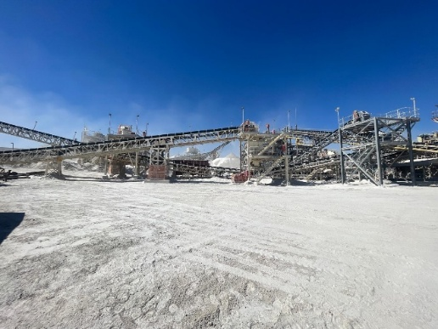
From there Andrew moved onto Uis, Andrada's flagship tin mine and processing plant. The deposit was first identified in 1911 and developed from 1958 by Imkor, part of South Africa's state-owned steel group Iscor, becoming one of the world's largest tin mines through the 1980s before closing in 1990 as the tin price fell and the relationship between South Africa and Namibia shifted. It sat dormant until Bushveld Minerals, and later AfriTin (since renamed Andrada), acquired it and Andrada now holds an effective 100% interest. For the year ended 28 February 2026, Andrada produced a record 1,036t of contained tin, up from 932t the year before. Ore processed rose to 1mnt but an expansion to lift throughput to between 2-2.5mntpa is underway, enabled by the addition of ore sorters and backed by recent equity investment and long-term debt funding. Alongside tin and tantalum, Andrada intends to commercialise the lithium petalite potential at Uis, having secured funding from the European Investment Bank last year to complete the necessary studies.

Uis had Andrew getting excited all over again. He feels it's not fully appreciated just how large the mine really is; a world class tin mine in its own right, now set to be bolstered by lithium (as petalite for the glass industry like the Arcadia mine in Zimbabwe which sold for US$434m in 2022 and Bikita for US$180m which is very similar as also has tin and tantalum) as well as tantalum. All of Andrada's projects have echoes of Cornish mining, and like Cornwall, all were hit hard when the tin price collapsed. Andrada’s Head of Exploration, Tim Marais has visited Cornwall, so there's no shortage of comparisons drawn between the two. Tin’s supply dynamic is particularly interesting as despite the strong price performance discoveries and new listings in tin have been scarce meaning that Andrada remains one of the few producing companies offering exposure to tin production.

Water has been a recurring question, but there's a good aquifer of non-potable water to draw on, and while rainfall is scarce, what does fall can be put to use; Andrew got a water surprise of his own in the K5 pit as seen above. Infrastructure in a country the size of Namibia is also a challenge and Andrada benefits from being connected to the main grid which keeps energy costs low. The concentrate is also dried using nothing more than the sun (see right).
Ore sorting looks set to be a real game changer for both Uis and Brandberg West; a trial ore sorter is already in place, with two more being brought in for the main operation. Andrew also got to watch and film a mine blast while he was there; look out for his upcoming management interview.
 |  |
Sorted ore; waste on the left and mineralized ore on the right. The Uis tin processing plant
There's also rubidium to add to the list. Andrew says he feels like a kid in a sweet shop with new surprises around every corner, and Uis' 105,000t of contained rubidium; currently selling for around US$24,000/kg; is the latest one. He knows that doesn't really mean it's worth US$2.5trn, but even with a very conservative view it clearly has some value, and right now the share price appears to attribute nothing to it.
For his final stop Andrew moved on to Lithium Ridge, a lithium spodumene deposit stretching around 9km, now a joint venture with SQM, one of the world's leading lithium producers. He was struck by the calibre of the partner; SQM wouldn't be committing to this level of funding if it didn't believe this could be a significant project. Strategics are certainly recognising the potential across Andrada’s portfolio even if the market more widely hasn’t as yet! SQM has funded an expanded 16,500m, 143-hole drilling programme, which has returned lithium intersections of up to 3.46% Li₂O from near surface, alongside associated tin and tantalum mineralisation. SQM agreed an earn-in deal on the project in 2024.
 |  |
Looking out over Lithium Ridge and some spodumene.
Andrew came away impressed by the quality of Andrada's partners, its banking relationships, and the management team. VSA has only recently been appointed joint broker, with research coverage likely to start soon, so Andrew won't pre-empt that; but he believes this can become a world class company in tin, tungsten and lithium, three of VSA's favoured commodities.
Andrew’s attention will now turn mainly to copper and gold with visits to Ongwe Minerals, West Wits Mining and Koryx Copper, although first we will let him have a day of down time to enjoy Swakopmund and catch up on some sleep.
Watch this space for Part Two with Ongwe Minerals, Koryx Copper & West Wits Mining coming soon…
