
Dispatch from Dubai 2025

Our Dear Leader is once again on his travels and this time he has started in Dubai. This was not a visit to explore a permanent move to get away from the looming Budget, although appealing, we know he does love the Cornish Lair.
This trip is to attend the Dubai Airshow with Aurrigo (AURR LON) to look for local partners for a potential “Hub” for the Middle East. Dubai is interesting, not just because of the vast capital in the region, but its huge focus on airlines and airports and plans to open a new airport with five runways and 400 gates with capacity for 260mn passengers annually. It has a stated ambition to be marketed as “airport of the future”, meaning advanced tech, biometrics, autonomous operations, smart air cargo, etc.

The ground handling for Dubai Airports is done by a “sister company” dnata and recently their CEO, Steve Allen, was quoted saying “We do see a future for autonomous vehicles in the new airport. We’re investing quite a lot in technology to run the airport using advanced machine learning and AI… You can imagine a constant flow down a single channel of autonomous vehicles … that’s a great opportunity for autonomy because it’s following a standard layout and standard processes.” As a salesman, our Dear Leader always says, “sell people what they want to buy” and it does look like dnata are very keen to buy autonomous airside vehicles and as Aurrigo is the World Leader it looks like this is a good place to be.
As well as Dubai Airports and dnata Andrew is visiting other ground handling companies and airlines as they are all looking for ways to go autonomous. Many of them also have VC arms to invest in new products and ways airports can become cleaner and more efficient. One exciting opportunity which combines autonomous vehicles with the Internet of Things is Andrew’s belief that aircraft will be able to talk to the vehicles around them. So as an example, an A320 as it approaches an autonomous baggage trolley will tell it exactly where and when to line up its cargo doors to make baggage and cargo loading and unloading seamless, safe and more cost efficient.
All the global players are at the Air Show and this trend really is global which is why Andrew gets so excited about the future of companies like Aurrigo (it’s not just that he loves the smell of Avgas). We are already seeing airports such as Changi, Zurich, Schiphol and Cincinnati trialling the Aurrigo product while UPS are trialling their autonomous cargo trolley. Recently, Warwick Brady the CEO of Swissport said “By integrating autonomous technologies into our operations, we are taking a next step in redefining ground handling – improving safety, boosting efficiency and supporting the sustainability ambitions of our airline and airport partners across our global network.”
In fact, many travellers forget that baggage handling, at check-in, inside airports used to be done manually. Our Dear Leader has been travelling for so long he does remember this although it was Denver Airport in 1995 that installed the first fully automated baggage-handling system (by BAE Systems) using laser bar-code scanning. Today this automation is taken for granted and it seems obvious that it will happen airside too in the next few years.
What really excites Andrew is the TAM (Total Addressable Market) because it is just huge and as Andrew puts it “to have the World leader of such a massive growing market based in Coventry in the UK is extraordinary. If it were based in Silicon Valley, it would already be a unicorn worth billions of $’s “
Andrew has been doing some calculations on the back of a fag packet and this is his thinking [we would stress though that Andrew is not an analyst but a very good salesman]. There are about 43,000 commercial airports worldwide (ICAO/ACI data), but only about 1,500–2,000 handle significant commercial passenger and cargo volumes (more than 1 million passengers per year).
Typical mid-to-large airports operate:
300–1,000+ baggage/cargo trolleys (depending on throughput, terminals, and apron design)
Replacement every 5–10 years, often staggered.
That implies a global installed base of roughly:
1,500 airports × 600 trolleys average = 900,000 trolleys in operation
Before airports go autonomous this means an annual replacement demand of about $1bn but going autonomous would grow this to nearer $10bn annually as the capex is higher but the operating cost much lower as baggage drivers, on a salary of around $30,000 a year, are no longer needed. This is a good thing as baggage handling has a very high turnover of staff (up to 50% annually) as it is not a particularly pleasant job. Exact figures on the number of airside baggage handlers are tricky to find but about 0.5mn and so the annual salary cost globally could be about $15bn and so it is quite easy to show that autonomous vehicles will save airports costs and will inevitably be standard. And this is just for passenger bags; similar sort of numbers could be run for cargo and in truth the whole airside will go autonomous.
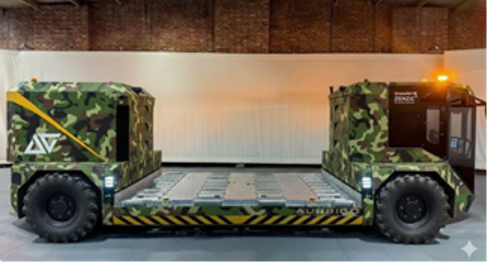
Finally, Andrew has one more thought on the Aurrigo autonomous vehicles. He is a great believer in AI, Autonomy and Robotics. What the Air Show has also made him focus on is the military application as he believes the days of humans on the battlefield are thankfully nearly over and we will never see the deaths of millions of
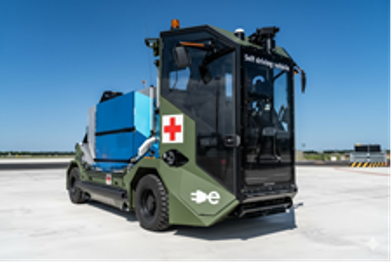
soldiers as we did in both World Wars. The Russian invasion of Ukraine has shown us that drones are the future in the air, but Andrew believes it will go much further and can see that an Aurrigo cargo trolley could easily become an autonomous missile launcher or an Aurrigo baggage dolly can become an autonomous “injured person recovery vehicle”. Andrew believes that Aurrigo has technology that could transform certain military equipment and that just could be the icing on what is already a huge cake. Andrew couldn't resist going onto Google Gemini and seeing what these military vehicles might look like.
Whilst on the military Andrew has noticed that the Air Show is well attended by Chinese and Russian exhibitors. On a single stand you can buy an attack missile and also a defence weapon to destroy it; well, that is one way to hedge your bets.
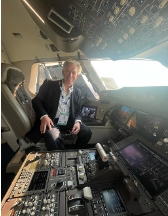
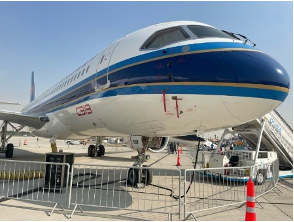
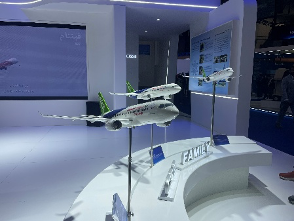
Andrew was also excited to go on board a COMAC 919 which is the Chinese equivalent of a Boeing 737 or A320. It seems inevitable to Andrew that China will soon stop buying aircraft from Airbus and Boeing which will disrupt the global aviation market and trade balance with Europe and USA.
Andrew attended a British Embassy networking drinks one evening and was surprised to meet familiar faces who had moved to Dubai as well as new ones across law, fund management and venture capital. He was also surprised by a short speech given by UK Labour Minister, Sir Chris Bryant which he thought was actually rather good (but no he still won’t be voting Labour). Clearly there is encouragement to support UK skills in the aerospace industry as it is a sector where we are global leaders.
Andrew now heads off to Hyderabad, India, for a few days to have discussions with Atri and colleagues who have recently been behind the raises for both Aurrigo and Invinity Energy Systems (IES LON) and who are keen to invest more in the Transitional Energy space.


